What is an eSIM and how does it work for international travel
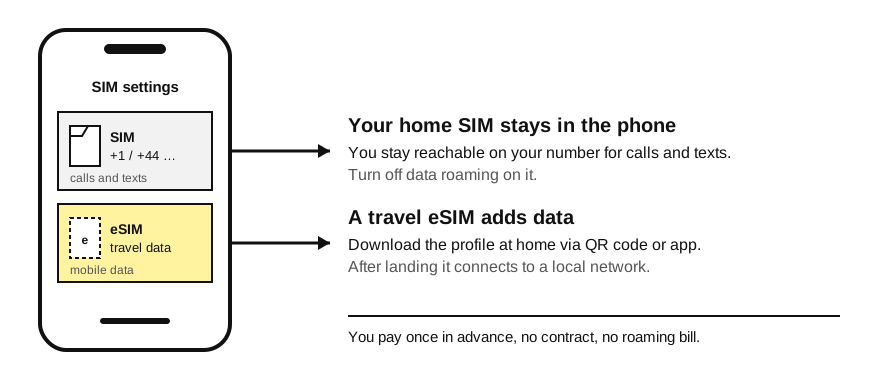
An eSIM is a SIM card you don't insert into your phone, because it is already built in. Instead of a plastic card, you download a carrier profile to your phone. When you travel, this means you can buy mobile data for your destination from home, and your phone connects to a local network as soon as you land.
What is an eSIM
The "e" stands for embedded. It is a small chip soldered directly into the phone. Unlike a physical SIM card, you can't take it out or swap it. The only thing that changes is what is stored on it: a carrier profile with a plan.
You install the profile by scanning a QR code or directly in the provider's app. One phone can store several profiles at once. You can keep your usual SIM from home and add an eSIM with data for Japan or Thailand next to it, then simply choose in settings which one handles mobile data.
Many carriers at home also offer eSIM as a replacement for the plastic card on a regular plan. This article is about the travel eSIM: a prepaid data package for a specific country or region that you buy only for the length of your trip.
How does an eSIM work when you travel
- Choose a plan by country, amount of data and number of days. You pay once in advance, with no contract and no monthly bill.
- Install the profile at home over Wi-Fi: scan the QR code or confirm the installation in the app. It takes a few minutes.
- After landing, select the eSIM for mobile data in settings and turn on data roaming for it. This is needed because the travel eSIM connects through a local carrier.
- On your home SIM, turn off data roaming. You stay reachable on your own number for calls and texts, but data runs only through the eSIM.
With most plans, the validity period starts only when you first connect in the destination country, so you can buy them in advance. The exact terms are listed in each plan's description on the provider's site.
Why an eSIM is useful for international travel
International roaming is expensive. Most US and UK carriers charge separately for data abroad, through daily passes or pay-per-use rates. A travel eSIM with a few gigabytes for a week usually costs from a few dollars to a few tens of dollars in popular destinations:
| Destination | Cheapest 5 GB for 7 days | Unlimited data for 7 days |
|---|---|---|
 Italy |
$9.60 Yesim | $23 Airalo |
 France |
$9.60 Yesim | $23.50 Airalo |
 Spain |
$8 Airalo | $23.50 Airalo |
 Mexico |
$12 Airalo | $23.50 Airalo |
 Japan |
$8.80 Yesim | $24.50 Yesim |
 Thailand |
$7 Airalo | $21 Airalo |
Prices from October 30, 2026, read daily from the provider websites. A plan may include more data or a longer validity if it is cheaper. How we compare
It works right after landing. You don't have to look for a local carrier's stand at the airport, show your passport or follow instructions in another language. Maps, translation and ride-hailing apps work from the first minutes.
You keep your own number. Your home SIM stays in the phone. You still get texts from your bank and incoming calls, you just don't pay roaming for data. You can make calls over WhatsApp, Signal or FaceTime using the eSIM data.
No plastic card to lose. You don't have to take out your home SIM, keep it in your wallet and put it back when you return.
You know the cost in advance. The plan is prepaid. When the data runs out, it simply stops working or you buy more. No extra bill arrives after your trip.
What about roaming in Europe?
The EU "roam like at home" rules let customers of EU carriers use their plan in other EU countries at domestic prices. These rules apply only to customers of EU carriers. If your phone plan is from a US carrier, Europe counts as international roaming like any other region, and your carrier's international rates apply.
Since Brexit, UK carriers are no longer bound by these rules. Several of them charge for roaming in the EU again, usually as a daily fee or as part of selected plans only. Check your own plan before you travel. In both cases a travel eSIM for Europe is an alternative with a price you know in advance, which is why we compare EU countries too.
eSIM compatible phones: how to check yours
The quickest way is to dial *#06#. If an EID is shown in addition to the IMEI, your phone supports eSIM. As a rough guide:
- iPhone XR, XS and later, iPhone SE from the 2nd generation. Models sold in mainland China are the exception. iPhone 14 and later models sold in the US have no physical SIM slot at all and work with eSIM only.
- Samsung Galaxy S20 and later, the foldable Z Fold and Z Flip series, some newer A series models.
- Google Pixel from the Pixel 3 series.
- Other brands such as Xiaomi, Motorola or Oppo support eSIM only on some models. Check with *#06# or in the SIM card section of your settings.
The phone must also be unlocked, meaning not locked to a single carrier. Carrier-locked phones are common in the US. Your carrier can tell you whether your phone is unlocked or can be unlocked.
What to watch out for
- Usually data only. A travel eSIM normally has no phone number of its own. For calls and texts, use your home SIM or apps.
- Install at home. You need an internet connection to download the profile. At an airport without data, this could be a problem.
- Don't delete the profile. A deleted eSIM often can't be installed again. After your trip, you can simply turn it off.
- Unlimited data has conditions. After a certain daily usage, speed may be reduced, and hotspot use is often limited. The terms are in the plan description.
- Top-ups. Some plans can be topped up on the same eSIM, for others you buy a new one. An overview by provider is on the home page.
eSIM vs physical SIM: travel eSIM, roaming or a local SIM card?
| Travel eSIM | Roaming with your carrier | Local SIM card | |
|---|---|---|---|
| When you get it | at home before the trip | nothing to do | at the destination |
| Price abroad | known in advance, prepaid | per your carrier's rates, often higher | usually low |
| Your home number | stays active | stays active | you have to swap cards or use dual SIM |
| Local phone number | usually not | no | yes |
| What you need | an eSIM compatible phone | nothing | a store, often a passport |
For a longer stay in one country where you need a local number, a local SIM card may work out better. For a regular vacation or business trip, a travel eSIM is the simplest option.
Where to buy an eSIM
Travel eSIMs are sold by specialized providers such as Airalo, Holafly or Yesim. Prices differ between them by country and amount of data. For the same package, the most expensive offer is often more than twice the price of the cheapest. We read them every day for 80 destinations. Choose a country, number of days and amount of data, and we show you the cheapest plan:
Frequently asked questions
Is an eSIM the same as a SIM card?
It works the same way, except that it is built into the phone instead of being a plastic card, and the plan is loaded onto it as a profile.
Can I have an eSIM and a physical SIM at the same time?
Yes. Phones with eSIM can use two lines at once, for example your home SIM for calls and a travel eSIM for data.
How do I activate an eSIM and how long does it take?
Installing the profile takes a few minutes: scan the QR code or confirm the installation in the provider's app. The connection to the network happens after landing, once you turn on the eSIM and data roaming.
Can I move an eSIM to another phone?
A travel eSIM is usually tied to the phone you installed it on. If you plan to change phones, install it on the new one.
Does an eSIM work in a tablet or smartwatch?
In tablets with cellular connectivity, such as iPads with eSIM, yes. Smartwatches use eSIM differently, tied to a carrier plan, and travel eSIMs generally don't work in them.