eSIM vs physical SIM: differences, pros and cons
An eSIM and a physical SIM card do the same job: they tell the network who you are and which plan you pay for. Calls, texts, data speed and coverage are the same. The difference is how the plan gets into your phone and what happens when you change phones, lose one or travel. If you are new to eSIM, start with what an eSIM is and how it works.
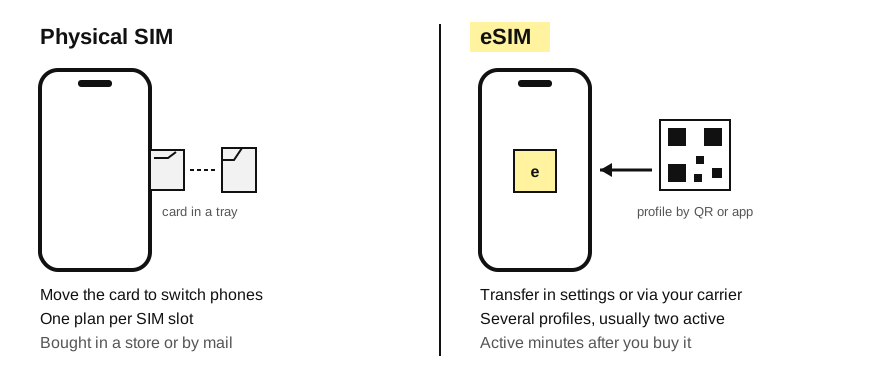
What is the same
- Network and speed. Both connect to the same carrier network. An eSIM is not faster or slower than a physical SIM on the same plan.
- Your number. A carrier can move your number from a physical SIM to an eSIM and back. The number and the plan stay the same.
- Calls and texts. They work the same way, including two-factor codes from your bank.
What is different
| eSIM | Physical SIM | |
|---|---|---|
| How you get it | download a profile by QR code or app, in minutes | pick it up in a store or wait for it in the mail |
| Switching phones | transfer in phone settings if your carrier supports it, otherwise ask the carrier for a new profile | move the card to the new phone |
| Several plans in one phone | several profiles stored, usually two active at once | one per SIM slot |
| If the phone is stolen | cannot be pulled out of the phone | can be removed and the phone taken offline |
| If the phone breaks | you need the carrier to issue a new profile | take the card out and use it in another phone |
| Phones | only phones with eSIM support | almost every phone |
| Travel data | buy a local data plan online before the trip | buy a local SIM card at the destination |
eSIM pros
- No waiting for a card. A new plan or a travel data package is active minutes after you buy it.
- Two lines in one phone. You can keep your own number on one line and use a second line for work or for data abroad.
- Nothing to lose or damage. There is no small card to drop, no tray to bend and no contacts to wear out.
- Harder to take offline. A thief cannot simply pull the SIM out, so the phone can stay connected for location tracking until it is switched off.
eSIM cons
- Changing phones takes a step more. Instead of moving a card, you transfer the eSIM in settings or ask your carrier. How easy that is depends on the carrier and the phone brand.
- A broken phone is a bigger problem. With a physical SIM you put the card in a spare phone. With an eSIM you need the carrier to issue a new profile first.
- Not every phone supports it. Older and cheaper models often only have a SIM slot.
- Deleted profiles may not come back. A deleted travel eSIM often cannot be installed again. Turn it off instead of deleting it.
Is eSIM better than a physical SIM?
For everyday use at home, neither is better. They use the same network at the same speed. The physical SIM is more practical if you often move your number between phones or keep a spare phone. The eSIM is more practical if you want two lines in one phone or travel abroad. In the US the choice is often already made: iPhone 14 and later models sold in the US have no SIM slot and work with eSIM only.
eSIM vs physical SIM for travel
This is where the difference matters most. You keep your physical SIM or eSIM from home in the phone for calls and texts, and add a travel eSIM for data. You buy it before the trip, install it over Wi-Fi at home and it connects to a local network when you land. With a physical local SIM card, you first have to find a store at the destination, often show a passport, and swap out your home SIM. Typical prices for a travel eSIM:
| Destination | Cheapest 5 GB for 7 days | Unlimited data for 7 days |
|---|---|---|
 Italy |
$9.60 Yesim 5 GB / 30 days Go to Yesim |
$23 Airalo Unlimited / 7 days |
 France |
$9.60 Yesim 5 GB / 30 days Go to Yesim |
$23.50 Airalo Unlimited / 7 days |
 Spain |
$8 Airalo 5 GB / 7 days |
$23.50 Airalo Unlimited / 7 days |
 Mexico |
$12 Airalo 5 GB / 7 days |
$23.50 Airalo Unlimited / 7 days |
 Japan |
$8.80 Yesim 5 GB / 30 days Go to Yesim |
$24.50 Yesim Unlimited / 7 days Go to Yesim |
 Thailand |
$7 Airalo 5 GB / 7 days |
$21 Airalo Unlimited / 7 days |
Prices from October 31, 2026, read daily from the provider websites. A plan may include more data or a longer validity if it is cheaper. How we compare
A local SIM card can still be the better choice for a long stay in one country where you need a local phone number. A travel eSIM usually has data only.
Compare travel eSIM prices
Travel eSIMs are sold by providers such as Airalo, Holafly or Yesim. For the same package, the most expensive offer is often more than twice the price of the cheapest. We read their prices every day for 94 destinations. Choose a country, number of days and amount of data:
Frequently asked questions
Can I use an eSIM and a physical SIM at the same time?
Yes, on phones that have both. You can keep your home number on the physical SIM and use an eSIM for data, or the other way round. In settings you choose which line handles calls, texts and mobile data.
Is an eSIM faster than a physical SIM?
No. Speed depends on the network and the plan, not on the type of SIM.
Can I switch from eSIM back to a physical SIM?
Yes, if your phone has a SIM slot. Your carrier issues a physical card for the same number and plan.
How do I check if my phone supports eSIM?
Dial *#06#. If an EID is shown next to the IMEI, the phone supports eSIM. The phone must also be unlocked to use an eSIM from another provider.